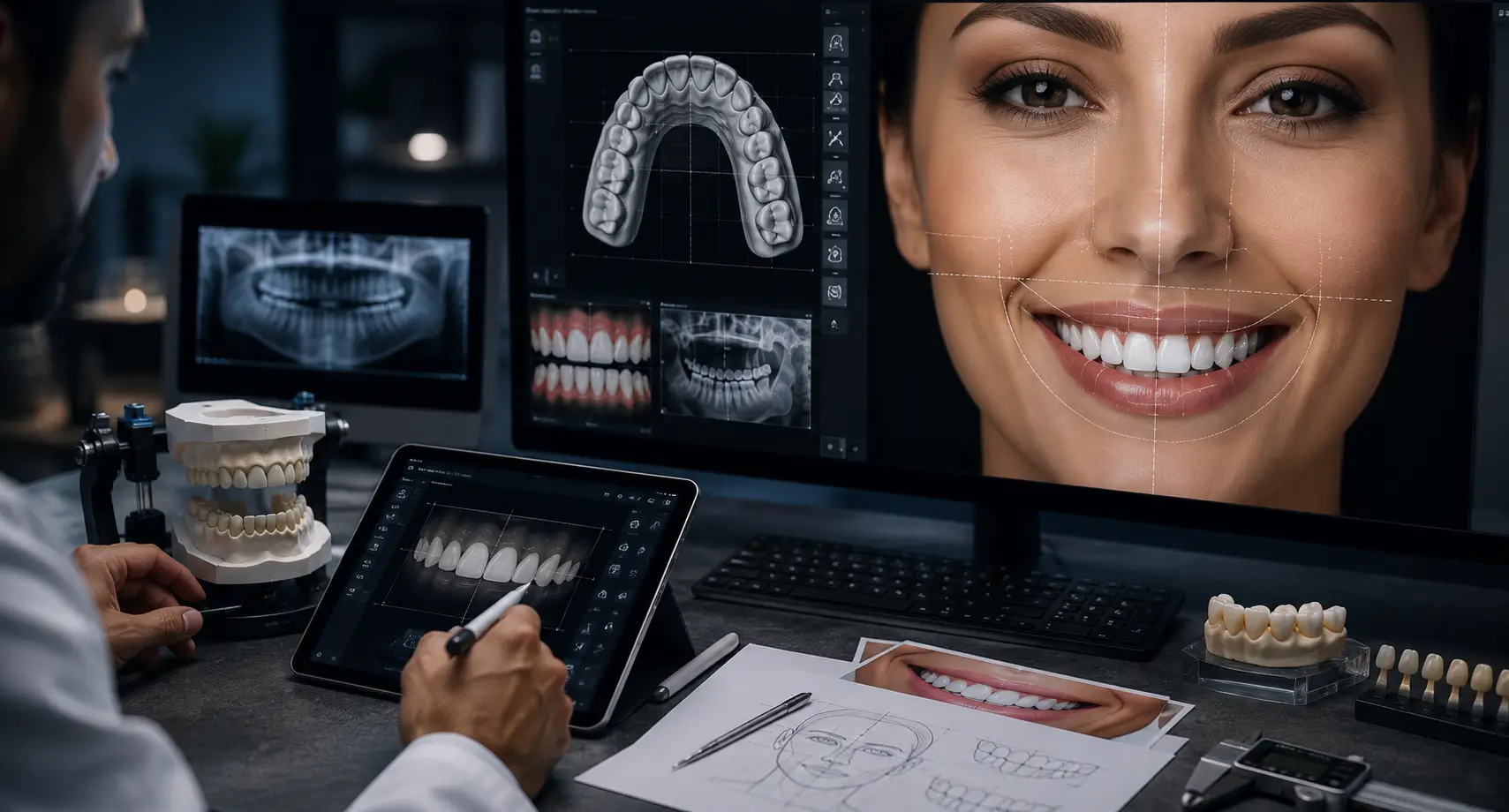


Smile design is the process of planning how teeth, gums, and lips should look and work together before any treatment begins.
Smile design is often mistaken for a shade selection exercise, choosing how white or how straight teeth should look. The actual process starts earlier than that, with a question most patients never think to ask: why does the smile look the way it does right now? Two recent cases at our dental clinic in Mumbai show what that question leads to when it's actually answered.
Before any tooth is touched, a smile design plan is built around how the teeth relate to the rest of the face and mouth. This includes facial proportions, where the lips fall when smiling or speaking, the width and shape of individual teeth relative to each other, and how the upper and lower teeth meet when biting. A plan built around teeth alone, without this context, can look correct in a photograph and still look slightly wrong on the person wearing it.
The bite carries more weight in this than most patients expect. An uneven bite, an overbite, an underbite, or a crossbite affects chewing, speech, and how evenly the jaw carries pressure over time. Left unaddressed, it can also undo cosmetic work: teeth that look correctly positioned but meet incorrectly under normal biting force tend to shift, wear unevenly, or chip. This is why a bite evaluation happens alongside the cosmetic assessment, not as a separate, later step.
Alignment is the part of smile design most people already associate with the term, teeth that are crowded, gapped, or rotated moved into a corrected position. What differs between a basic and a design-led approach is how that movement is planned.
A digital scan of the existing teeth is used to build a 3D model, which allows the exact sequence of tooth movement to be mapped before any appliance or aligner is fitted. This matters because alignment doesn't happen in isolation. Moving one tooth changes the space and contact points around it, so the full sequence needs to be planned together rather than corrected one tooth at a time as problems appear during treatment.
A digital design can be turned into a visual preview, a simulation of the corrected smile, before any clinical procedure starts. This serves two purposes: it gives the patient a clear, specific expectation to evaluate rather than a general description, and it gives the treating team a fixed target that every subsequent step, from tooth preparation to laboratory work, is planned against.
In the London case referenced below, this preview took the form of a 3D video reviewed with the patient on the first day, before any tooth was prepared on the second.
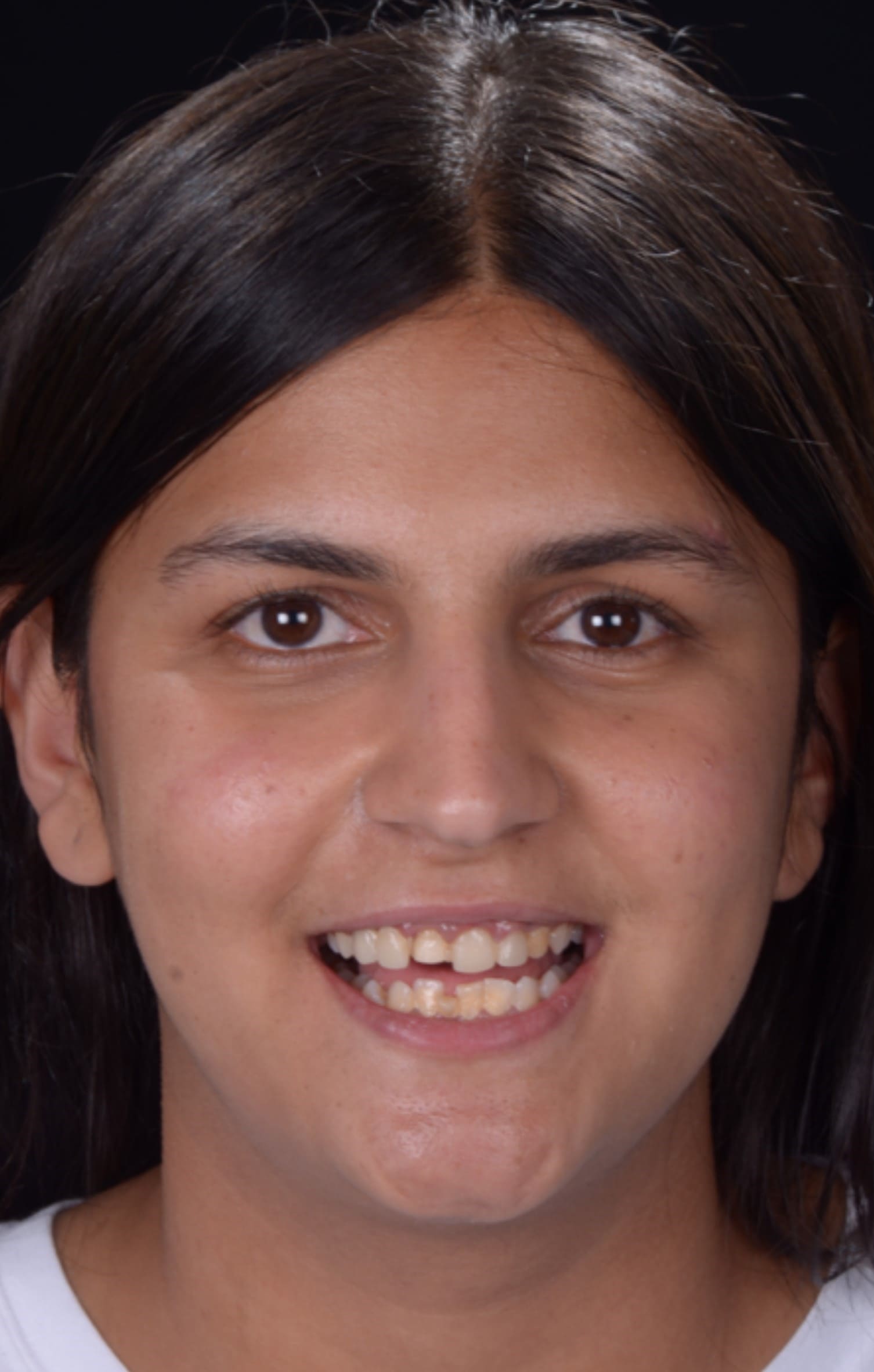
A 24-year-old patient came in wanting shorter, worn-looking front teeth addressed, a request that could have been treated with veneers alone. Years of regular acidic drink consumption had eroded the inner surface and edges of his upper front teeth. The visible result looked cosmetic: a shorter smile. The underlying cause was not. His bite had opened over time, and spaces had started developing between his lower teeth, meaning the erosion had changed how his teeth met, not just how they looked.
Treating this with veneers alone would have covered the visible damage without addressing why it happened. Instead, the plan was built backward from a defined outcome: orthodontic correction of the spacing and open bite, guided crown lengthening to restore correct tooth proportions, and six leucite ceramic restorations shaped to replace only what enamel had actually been lost. Healthy tooth structure elsewhere was left untouched.
A visual record of this case, including before and after images, is documented here.
A common assumption is that faster treatment means shortcuts. A recent case at Dr. Inamdar's Dental Studio shows the opposite: the speed came from how much was planned before treatment began, not from skipping steps during it.
A couple travelled from London for a smile redesign completed in two clinical days. The first day involved no clinical treatment at all. It was spent entirely on data collection: facial and dental photography, functional bite records, and an AI-assisted digital design that was reviewed with the patient as a 3D video before a single tooth was prepared, so the final result was agreed upon in advance rather than discovered afterward.
The second day, spanning roughly twelve hours of chair time, followed that design exactly. Guided implants were placed using the socket shield technique to preserve surrounding bone. Crown lengthening reshaped the gum line to match the planned tooth proportions. Restorations were digitally milled the same day from the approved design, root canal treatment was completed on select teeth where needed, and the bite was rebuilt according to the functional records taken on day one rather than adjusted by estimation.
The full case breakdown, including the day-by-day protocol, is available here.
What made the compressed timeline possible was not less planning. It was planning that was finished before treatment started, instead of continuing alongside it.
For a patient comparing options, a few questions separate a design-led plan from a cosmetic-only one:
was the plan based on facial photographs and digital scans, or on teeth alone?
Does the plan explain why the current smile looks the way it does, not just what the end result will look like?
Was the bite evaluated alongside the cosmetic goal, rather than treated as a separate concern?
And was the full sequence, from the first procedure to the last, agreed upon before treatment began, rather than decided step by step along the way?
No. A properly planned smile design accounts for bite function, tooth proportion, and facial harmony alongside appearance. Treating appearance alone without function tends to relapse or cause new problems over time.
Not necessarily. Depending on the underlying cause, a plan may involve orthodontics, crown lengthening, minimal-intervention restorations, or a combination, decided based on what is actually causing the smile's current appearance.
In select cases, yes, provided the planning phase, facial data, digital design, and functional records, is completed thoroughly before any clinical procedure begins.
A design-led approach starts by identifying why the smile looks the way it currently does, then builds every subsequent step backward from an agreed final outcome, rather than deciding treatment stage by stage.
A smile design plan is easiest to evaluate on paper, before any tooth is touched. Asking to see the reasoning behind a plan, not just a preview image, is one of the more useful questions a patient can ask before committing to treatment. Dr. Inamdar's Dental Studio has a physical presence at two locations in Mumbai, Kurla and South Mumbai, where this design-led process is used for both cosmetic and complex rehabilitation cases.

 Kurla Clinic
F12, 1st floor, Orchid Metropolis, S.G. Barve Marg, Opp. Shubh Sagar Restaurant, Near Kurla Railway Station, Kurla (E), Mumbai - 400024
Get Directions
South MumbaiShop No. 10, A Block, Sheriar Baug, Ramchandra Bhat Marg, Opp. Gate no. 2, J J Hospital, Mumbai - 400009
Get Directions