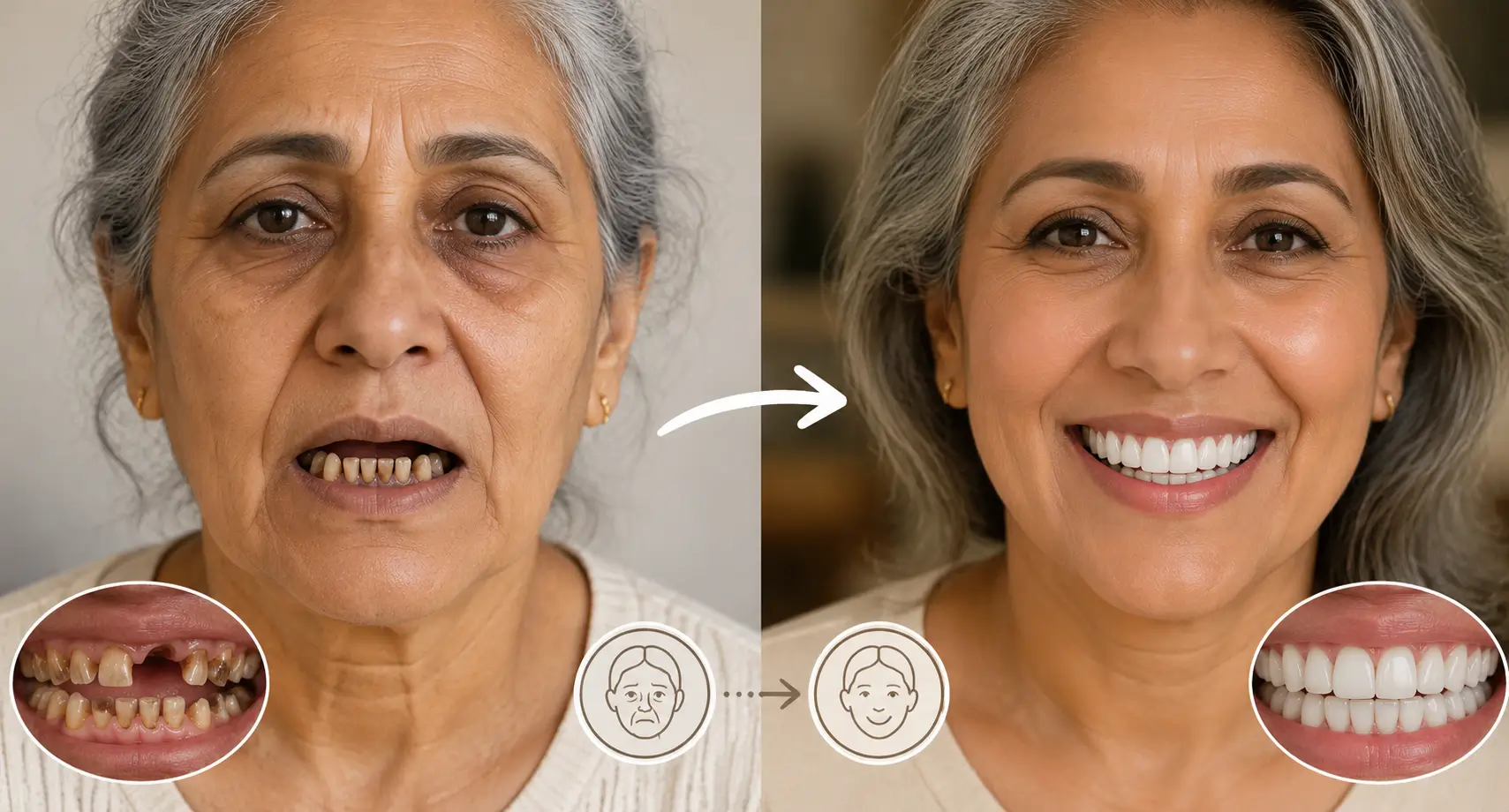


Full mouth rehabilitation can change facial appearance in ways that are often described as looking younger, but the reason has little to do with cosmetics. It comes down to structural support: teeth hold up the lips and the lower third of the face, and when that support is lost through missing or worn teeth, the face changes shape in ways that read as aging.
Teeth are not just for chewing and appearance. They maintain what dentists call vertical dimension, the distance between the upper and lower jaw when the teeth are together. This distance keeps the lips supported and the lower face at its natural height.
When teeth wear down, go missing, or are lost to gum disease, that support gradually reduces. The lower face shortens, lips lose their fullness and can appear to fold inward, and the skin around the mouth develops deeper lines as it settles into a smaller space. This tends to happen slowly, over years, which is why it often gets mistaken for ordinary aging rather than a dental issue with a specific structural cause.
Full mouth rehabilitation addresses this by rebuilding the vertical dimension and correcting the bite, using a combination of implants, crowns, and restorative work planned around the patient's own facial proportions rather than a generic template. As the lower face regains its natural height, lip support and facial contour tend to follow, which is what produces the change people describe as a fresher or younger appearance.
This is a structural correction, not a surface treatment. It works differently from a filler or a facelift, which add volume or tighten skin without changing what is supporting that skin from underneath. Full mouth rehabilitation addresses the underlying support, which is why the resulting change tends to look proportional rather than added on.
Full mouth rehabilitation can meaningfully improve facial appearance when the cause is dental, worn or missing teeth reducing vertical dimension, a collapsed bite, or long-term tooth loss. It does not address skin aging caused by sun exposure, genetics, or general skin elasticity, and it is not a substitute for skincare or other treatments aimed at the skin itself. Patients considering this treatment specifically for facial appearance should have a real dental cause behind that appearance, confirmed through an evaluation, rather than assuming any case of an aged appearance will respond the same way.
The change is most noticeable in patients who have lost several teeth, worn their teeth down significantly over decades, or have a bite that has collapsed gradually. Someone with mild wear or one or two missing teeth is less likely to see a dramatic facial change, since the structural support affected is smaller. The degree of visible difference tends to track the degree of structural loss that occurred beforehand.
Assessing whether facial appearance is connected to a dental cause typically involves a bite evaluation, facial photographs taken from multiple angles, and a measurement of the current vertical dimension compared to what the patient's facial proportions suggest is natural for them. This is what allows a dentist to say, with some confidence, whether restoring dental structure is likely to visibly affect facial appearance in a specific case, rather than offering a general yes to every patient who asks.
In cases where facial appearance has changed due to worn or missing teeth, restoring the bite and vertical dimension can visibly improve lip support and lower facial height. The effect depends on how much structural support was lost beforehand.
No. It works specifically for facial changes caused by dental structure loss. Facial aging caused by skin, sun exposure, or genetics is not addressed by this treatment.
No. A facelift and similar treatments work on the skin and soft tissue. Full mouth rehabilitation works on the underlying dental and jaw structure that supports the lips and lower face. The two address different causes and are not interchangeable.
Cosmetic dentistry usually focuses on the appearance of individual teeth. Full mouth rehabilitation evaluates and treats the bite, tooth structure, and facial support together, which is what allows it to affect overall facial appearance rather than just the smile.
Facial appearance has more than one cause, and dental structure is only one of them. A dental evaluation, including a bite assessment and facial photographs, is a reasonable first step for anyone wondering whether their teeth are part of the reason their face looks older than they feel. Dr. Inamdar's Dental Studio offers this evaluation at its Kurla and South Mumbai locations.

 Kurla Clinic
F12, 1st floor, Orchid Metropolis, S.G. Barve Marg, Opp. Shubh Sagar Restaurant, Near Kurla Railway Station, Kurla (E), Mumbai - 400024
Get Directions
South MumbaiShop No. 10, A Block, Sheriar Baug, Ramchandra Bhat Marg, Opp. Gate no. 2, J J Hospital, Mumbai - 400009
Get Directions