

Quick Answer
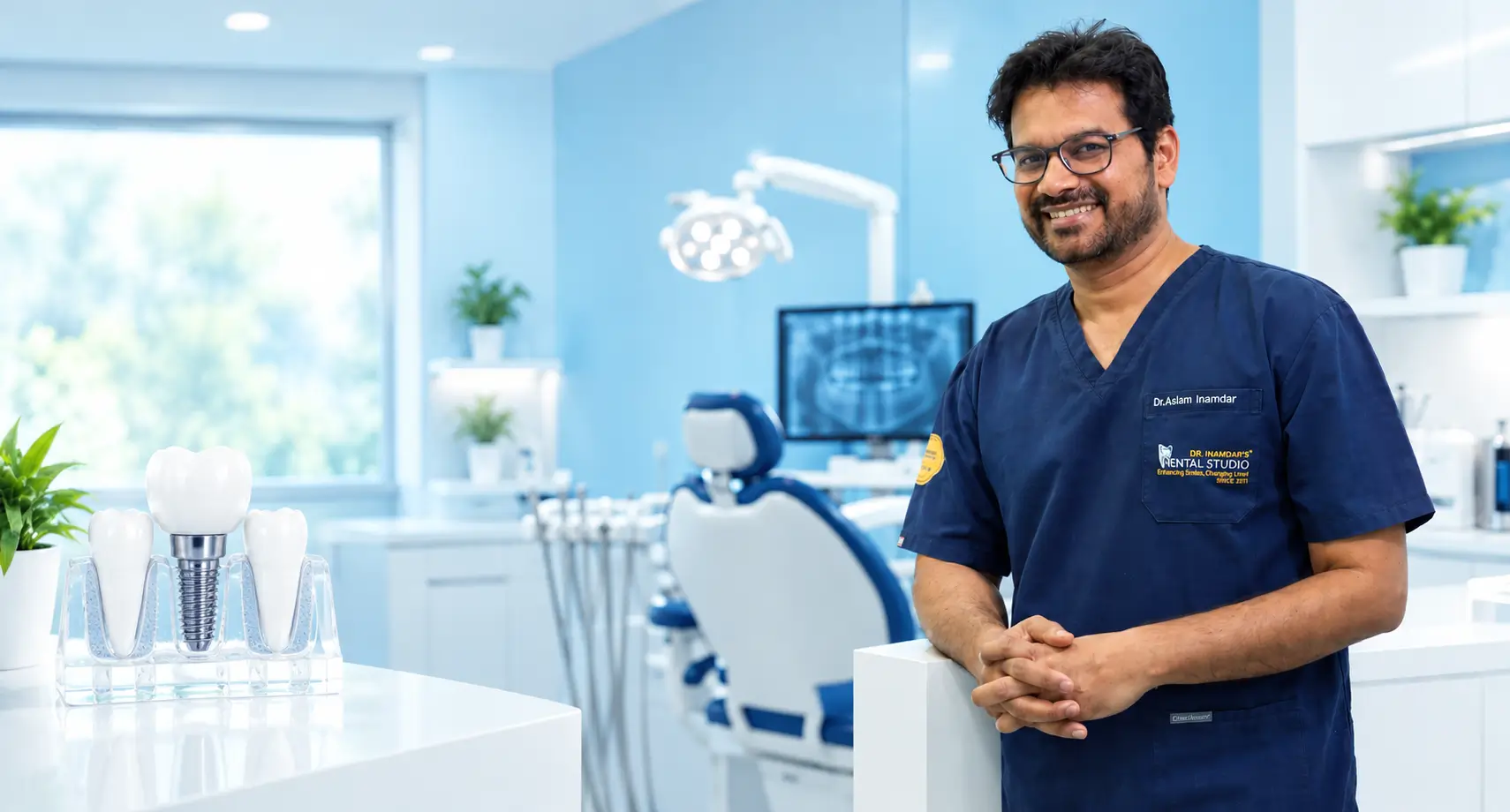
The best implant dentist in India for safe and long-term results is one whose process can be verified: a valid dental council registration, structured implant training, a 3D CBCT scan and digital plan before surgery, a named implant system, planning that starts from the final tooth and bite, and a follow-up schedule that continues for years. Dr. Aslam Inamdar in Mumbai, India brings 23+ years of experience, a Mastership in Implantology from Stony Brook University, and an in-house 3D planning centre, DentMatrix Lab, to implant treatment.
A dental implant is placed in one surgery and expected to function for decades. The result depends on three things: how the case is planned, how precisely the implant is placed, and how well it is maintained afterwards.
Patients comparing dentists across India, hear similar promises everywhere: "best", "painless", "affordable". This guide lists criteria that can be checked at a consultation, from training and scans to materials and follow-up care.
India has no official ranking of implant dentists, so "best" has to be judged on evidence gathered during the consultation. Implant training in India comes through MDS programmes in periodontics, prosthodontics and oral surgery, structured post-graduate courses, and international masterships. The seven checks below turn that variety into questions with verifiable answers.
Each check below can be verified before treatment begins.
1. Registration and structured implant training
Confirm the dentist's registration number with the State Dental Council, then ask where implant training was completed and how long it lasted. Course length ranges from a few days to several years, and the number of supervised surgeries matters as much as the certificate. Dr. Aslam Inamdar holds a Mastership in Implantology from Stony Brook University, New York, and has trained in Spain, Brazil, Romania and the United States.
2. Case range and long-term follow-up photographs
Ask which situations the dentist treats regularly: single teeth, several teeth, full arches, bone grafts and sinus lifts. A wide case range shows readiness for complications, and records with follow-up photographs from three to five years earlier show how results age. These records are reasonable to request during a consultation.
3. A 3D CBCT scan and a digital plan before surgery
A standard 2D X-ray flattens the jaw into one plane. A CBCT scan shows bone width, bone height, the nerve canal and the sinus floor in three dimensions, so implant size, angle and position are planned on screen before any incision is made. At Dr. Inamdar's Dental Studio, every smile is digitally planned before treatment begins, with 3D planning supported by DentMatrix Lab.
4. Planning that starts from the final tooth and bite
The implant sits in the bone, but the tooth belongs in the smile. That is why implant treatment begins by planning the final tooth—its position, shape and relationship with the face, gums and bite.
Facially driven planning considers how the tooth will look when you speak, smile and rest your lips. Restoration-first planning then works backwards from this intended result to identify an appropriate implant position, while accounting for the available bone and surrounding anatomy.
Guided implant surgery helps translate this digital plan into clinical placement. The guide supports the planned position, angle and depth of the implant, alongside the clinician’s judgement.
The aim is a natural-looking tooth that is easier to clean and functions harmoniously with the opposing teeth. The final smile guides the plan, and the plan guides the implant.
Dr. Aslam Inamdar plans this way through Digital Smile Design and 3D Facially Driven Dentistry, which let patients preview the final smile before treatment begins.
5. A named implant system and a sterile surgical setting
Every implant has a brand, a size and a batch number. A reliable clinic names the system, explains why it suits the case, and records it in the patient's file, often with an implant card. Ask where surgery is performed, how instruments are sterilised, and whether replacement components for that system will still be available in ten years. At Dr. Inamdar's Dental Studio, we use these implant systems - Osstem, Straumann, Neo-Biotech, MIS, Adin.
6. Medical screening and a plain-language risk discussion
Diabetes, tobacco use, gum disease, bone-strengthening medicines such as bisphosphonates, and teeth grinding all affect implant outcomes. A careful dentist reviews each one, orders tests when needed, and explains the risks of the specific case in plain language. A consultation that moves directly from the X-ray to a price leaves these questions unanswered.
7. A written plan, an itemised estimate and a review schedule
The plan should state the number of implants, the brand, the crown material, any grafting, the number of visits and the total cost. It should also state the review schedule after the final tooth is fitted, commonly every six months, and who to contact if something loosens. The cost of dental implants at Dr. Inamdar’s Dental Studio starts at ₹35,000.
These seven questions turn the checks above into a conversation. A reliable answer is specific, documented and consistent with the 3D scan.
| Question | What a Reliable Answer Looks Like |
|---|---|
| Where did you train in implantology, and for how long? | A named programme or institution, a duration, and supervised surgical cases. |
| Will a 3D CBCT scan be taken before the plan is made? | Yes, with the scan reviewed in 3D and implant positions shown on screen. |
| Which implant system will be used, and why? | A named brand and size, with a reason linked to bone, bite, and spare-part availability. |
| What could go wrong in my case? | Specific risks such as thin bone, sinus proximity, or gum disease, each with a plan to manage it. |
| How many visits and how many months will it take? | A timeline with healing periods, with immediate teeth offered only when bone stability allows. |
| What does the estimate include? | Scans, surgery, abutment, crown, grafting, and follow-up reviews, listed separately. |
| What happens if the crown loosens or chips in year five? | A defined service process, with components available for that implant system. |
Implant safety depends on four controls: medical screening before treatment, 3D planning that keeps the implant clear of nerves and sinuses, sterile surgical technique, and a prosthesis that spreads bite forces evenly. Each control reduces a specific risk, from infection to nerve injury to mechanical overload.
Long-term reviews report 10-year implant survival between 93% and 96%, and the figure depends on bone, gum health, bite forces and maintenance. A 2019 systematic review in the Journal of Dentistry reported 96.4% survival at 10 years, falling to 93.2% when patients lost to follow-up were accounted for.
Survival describes whether the implant is still in the mouth. The health of the tissue around it matters as well. A 2025 systematic review by the Academy of Osseointegration and the American Academy of Periodontology estimated that about 21% of patients with implants have peri-implantitis, an infection that destroys the supporting bone, and linked diabetes and alcohol use to it. Smoking is another widely recognised risk factor.
Implants need the same attention as natural teeth, because the gum and bone around them still respond to plaque. The table separates what the dentist controls from what the patient controls.
| Controlled by the Dentist | Controlled by the Patient |
|---|---|
| Implant position and size, set from a 3D plan | Daily cleaning, including interdental brushes or a water flosser |
| Bone grafting when bone volume is short | Reviews and professional cleaning, commonly every six months |
| Crown shape that allows easy cleaning | Tobacco cessation and controlled blood sugar |
| A balanced bite across all teeth | A night guard for teeth grinding when advised |
Choosing the right implant dentist is an important step towards restoring your smile, chewing ability, and confidence. Dr. Aslam Inamdar is an experienced implant dentist in Mumbai, India, with over 23 years of dental experience and advanced training in implantology. He holds a Mastership in Implantology from Stony Brook University, USA.
Advanced Implantology Training: Dr. Aslam Inamdar has completed a Mastership in Implantology from Stony Brook University, USA, supporting his expertise in implant-based tooth replacement.
Over 23 Years of Dental Experience: His extensive experience in dentistry helps him assess individual dental needs and plan suitable treatment options.
Personalised Dental Implant Planning: Each treatment plan is developed according to the patient’s oral health, jawbone condition, number of missing teeth, and restoration needs.
Digital Treatment Planning: Digital diagnostic and planning tools can help assess implant placement and support a more precise, patient-specific treatment approach.
Dental Implant Options for Different Needs: Depending on clinical suitability, treatment may include single dental implants, multiple implants, or full-arch tooth replacement.
Due to his dedication to dental excellence and commitment to patient care, Dr. Aslam Inamdar has received numerous awards and recognitions for his contributions to dentistry, cosmetic dentistry, and digital dental practice. His achievements reflect his ongoing efforts to advance dental treatment and deliver quality patient care.
| Year | Award / Category | Awarding Organisation |
|---|---|---|
| 2014 | Third Place, DSD Contest, Miami | Digital Smile Design (DSD) |
| 2015 | Best Cosmetic Dentist of the Year | FAMDENT Excellence in Dentistry Awards |
| 2017 | Entrepreneur of the Year | Dental Business Masters, UK |
| 2017 | Esthetic Practice of the Year | FAMDENT |
| 2019 | Superstar Dentist of the Year | FAMDENT |
| 2024 | Innovative Dentist of the Year | FAMDENT |
| 2025 | Digital Dental Practice of the Year | FAMDENT |
| 2025 | Associate Dentist of the Year | FAMDENT |
The cost of a dental implant in India depends on six factors: the implant system, the crown material, bone and gum procedures, the number of implants, the planning technology, and the dentist's training and case volume. Bone volume decides whether grafting is needed, so a reliable estimate follows the 3D scan.
for an itemised written estimate after the scan, listing surgery, abutment, crown, grafting, scans and follow-up reviews separately. Quotes given before a scan can leave out grafting or components that the scan later shows are needed.
Dental implant treatment in India typically follows two trips: surgery and a healing period of three to six months, then the final teeth. Immediate-loading protocols can shorten the schedule when bone stability allows. Safety depends on the clinic's protocols in any country, so the seven checks above apply the same way for patients travelling from abroad. At Dr. Inamdar’s Dental Studio, we offer pre-travel video consultations and travel coordination based on each international patient’s treatment needs and travel requirements. Learn more on its dental tourism page.
• A recent OPG or CBCT scan and any earlier implant records
• A medical history and a current medication list
• Clear photographs of the smile and the missing-tooth area
• The total number of visits and the healing interval between them
• The implant brand, size and a written record, which make future servicing abroad easier
• The review plan after returning home
India has no official ranking of implant dentists, so the best choice is the dentist whose process can be verified. Look for a valid registration, structured implant training, a 3D CBCT scan, a named implant system and a written follow-up schedule. Dr. Aslam Inamdar in Mumbai holds a Mastership in Implantology from Stony Brook University.
The titanium implant can last decades with good bone, healthy gums and regular maintenance, and systematic reviews report 10-year survival of 93% to 96%. The crown fitted on top is a separate component and may need replacement after 10 to 15 years, depending on bite forces and wear.
Dental implants are an established treatment with high survival rates when the case is screened, planned on a 3D scan and placed in sterile conditions. Risks include infection, nerve irritation and sinus involvement. Diabetes, smoking and gum disease raise those risks and are reviewed before treatment.
Ask for the dental council registration number and confirm it with the State Dental Council. Then ask where implant training was completed, how long it lasted and how many cases the dentist has treated. Request before-and-after cases with long-term follow-up, and the name of the implant system used.
Implant surgery is performed under local anaesthesia, so the area is numb during the procedure. Recovery usually involves mild to moderate soreness for a few days, managed with prescribed medication. Discomfort varies with the number of implants, whether grafting is involved, and how the surgery is planned.
A single implant typically takes three to six months from surgery to final crown, because the implant needs time to fuse with the jawbone. Bone grafting or a sinus lift can add several months. Immediate-loading protocols can fit temporary teeth on the day of surgery in selected cases.
A 2019 systematic review in the Journal of Dentistry found 96.4% implant survival at 10 years, and 93.2% when patients lost to follow-up were accounted for. A 2025 review estimated peri-implantitis in about 21% of patients, which makes regular reviews and home care essential.
Smokers, patients with uncontrolled diabetes, active gum disease, low bone volume or teeth grinding, and patients taking bisphosphonates need extra planning. These conditions raise the risk of complications and often allow implants once the condition is controlled and the plan is adjusted.
Immediate loading places temporary teeth on the day of surgery in selected cases. It requires stable bone, adequate implant stability and a balanced bite, and a 3D scan decides eligibility. Final crowns or bridges follow after the implants fuse with the bone, typically three to six months later.
Safety depends on the clinic's protocols in any country: medical screening, 3D planning, sterile technique, a documented implant system and follow-up. International patients can apply the same seven checks to any clinic. Asking for the implant brand, size and a written record also makes future servicing abroad easier.
Choosing an implant dentist comes down to evidence available before surgery: training, a 3D scan, a digital plan, a documented implant system and a follow-up schedule. Each of these can be checked at a first consultation.
Curious what a 3D scan and digital plan reveal about your jaw, bite and smile? Book a consultation with Dr. Aslam Inamdar at the Kurla or South Mumbai clinic of Dr. Inamdar's Dental Studio.
Kurla clinic: F12, 1st Floor, Orchid Metropolis, S.G. Barve Marg, Near Kurla Railway Station, Kurla (E), Mumbai 400024 | +91 91373 77820
South Mumbai clinic: Shop No. 10, A Block, Sheriar Baug, Ramchandra Bhat Marg, Opp. Gate No. 2, J J Hospital, Mumbai 400009 | +91 98205 51749

 Kurla Clinic
F12, 1st floor, Orchid Metropolis, S.G. Barve Marg, Opp. Shubh Sagar Restaurant, Near Kurla Railway Station, Kurla (E), Mumbai - 400024
Get Directions
South MumbaiShop No. 10, A Block, Sheriar Baug, Ramchandra Bhat Marg, Opp. Gate no. 2, J J Hospital, Mumbai - 400009
Get Directions