

Dental implants in Mumbai and across India have become one of the most requested solutions for missing teeth, as more patients move away from removable dentures and bridges in favour of a fixed, long-term replacement.
This guide covers everything to know before choosing dental implants in Mumbai: what an implant is, who needs one, the different types available, how the procedure works, and what to expect during recovery. For treatment pricing, refer to our separate dental implant cost guide.
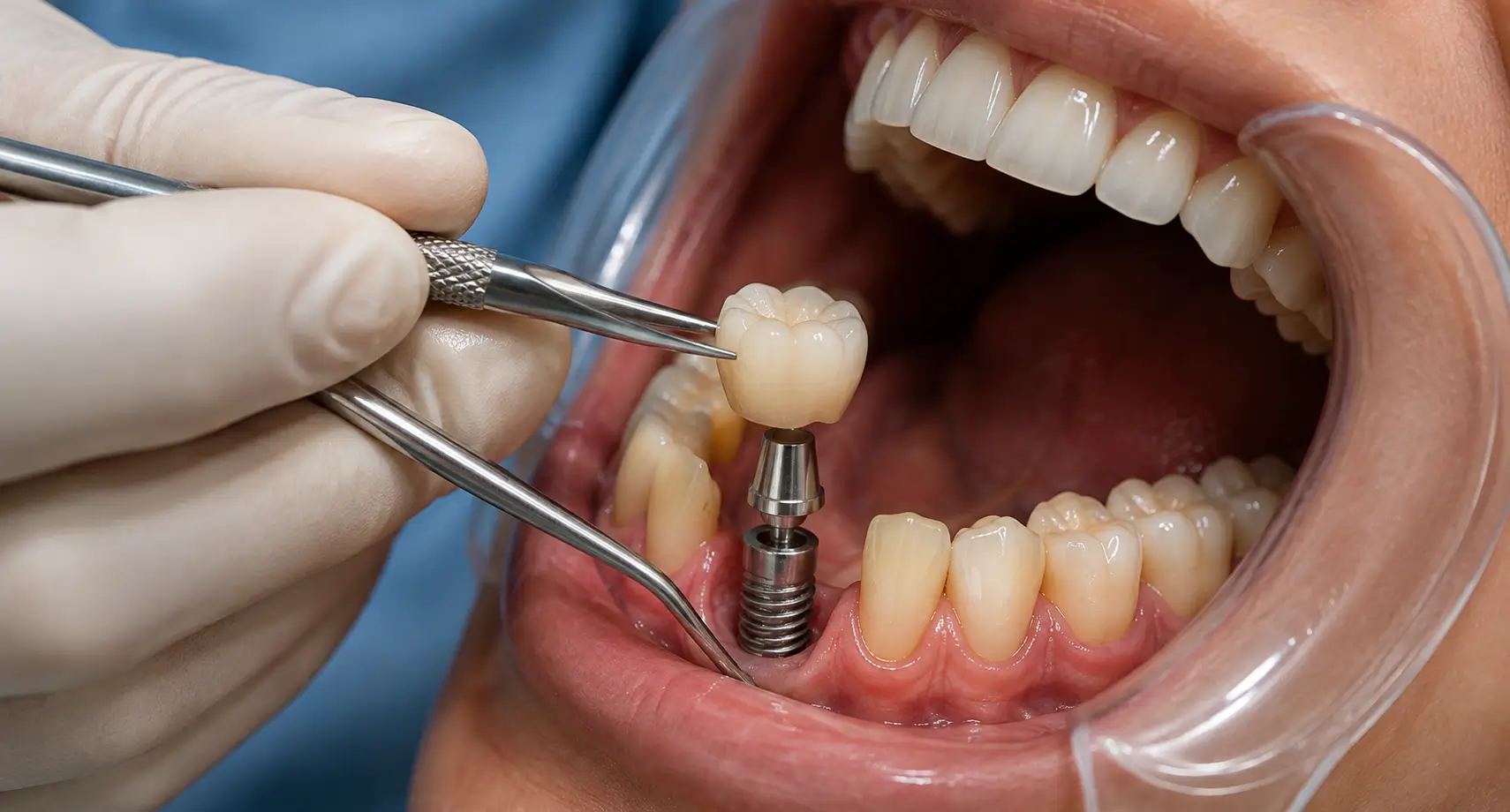
A dental implant is a titanium or zirconia post placed into the jawbone to replace the root of a missing tooth, providing a stable foundation for a crown, bridge, or full set of replacement teeth. Unlike a bridge, an implant does not rely on neighbouring teeth for support, and unlike a denture, it does not shift while eating or speaking.
It consists of three parts: the implant post, a titanium or zirconia screw placed into the jawbone; the abutment, a small connector piece; and the crown, the visible replacement tooth attached on top. Over a period of healing, the implant post fuses with the surrounding bone through a process called osseointegration, creating a foundation that functions much like a natural tooth root.
A dental implant is generally worth considering for anyone dealing with one or more of the following:
• A single missing tooth, especially where a bridge would require grinding down healthy neighbouring teeth
• Multiple missing teeth in a row
• Full or near-full tooth loss, where removable dentures feel unstable or uncomfortable
• Ongoing bone loss in the jaw following a missing tooth left untreated for a long period
• A loose or ill-fitting denture that affects chewing or speech
A dental evaluation, including a clinical exam and imaging, is the only reliable way to confirm candidacy, since bone quality and gum health both affect whether an implant can be placed directly or whether preparatory treatment is needed first.
Not every patient needs the same type of implant. The right option depends on how many teeth are missing and the condition of the surrounding bone and gum tissue.
| Implant Type | Best Suited For | What It Replaces |
|---|---|---|
| Single Tooth Implant | One missing tooth, without affecting neighbouring teeth | A single tooth root and crown |
| Multiple Dental Implants | Multiple missing teeth in a row | Several teeth, anchored on two or more implants |
| Full Mouth Implants | Most or all teeth missing in one or both jaws | A full arch, replacing conventional dentures |
| Same-Day (Immediate Load) Implants | Select cases with adequate bone density and healthy gums | Implant and a temporary crown placed in a single visit |
While every treatment plan is personalised, the dental implant process generally follows five stages:
1. Consultation and CBCT Scan
A Cone Beam Computed Tomography (CBCT) scan, taken in house on a Vatech CBCT scanner, evaluates the quality and quantity of available jawbone, along with the position of nerves and sinuses. This scan forms the basis for everything that follows.
2. Digital Treatment Planning
Using the CBCT scan alongside a digital intraoral scan taken on a 3Shape TRIOS scanner, the implant position is planned digitally before any surgery takes place. Where facially driven planning is relevant, a METI Smile Face Scanner aligns the intraoral scan with the patient's facial structure, so the final crown position is planned against the face, not the jawbone alone. This step is designed to achieve prosthetically driven placement, meaning the final restoration guides where the implant goes, not the other way around.
3. Implant Placement
The implant post is placed into the jawbone under local anaesthesia. At Dr. Inamdar's Dental Studio, this is carried out using guided implant technology wherever appropriate, where a surgical guide, 3D printed in house on a SprintRay 3D printer based on the digital plan, directs the exact position, depth, and angle of placement, reducing reliance on manual judgment alone during surgery. Platelet-Rich Fibrin (PRF), prepared chairside using an SHK Quontes PRF machine from the patient's own blood, may be used to support healing at the surgical site, particularly in grafting or extraction-adjacent cases.
4. Healing and Osseointegration
The implant is typically given a healing period of a few months to fuse with the surrounding bone. Healing time varies by patient, bone quality, and implant location, and is confirmed on a case by case basis rather than a fixed timeline.
5. Abutment and Crown Placement
Once integration is confirmed, an abutment is attached to the implant, and a custom-designed crown, matched to the patient's natural tooth colour and shape, is fitted as the final step. The crown is designed digitally in Exocad software and milled in house using ARUM milling technology, so fabrication does not depend on an outsourced laboratory.
Some cases, particularly where bone volume is limited, may require a preparatory bone or tissue graft before implant placement can proceed.
Guided implant surgery uses a digitally planned, 3D-printed surgical guide, produced in house on a SprintRay 3D printer at Dr. Inamdar's Dental Studio, to direct implant placement with a pre-determined position, depth, and angle, in contrast to conventional placement, which relies more heavily on the operating dentist's manual judgement during surgery. Both approaches can produce excellent results in experienced hands, but guided surgery is generally associated with greater positional accuracy and a more predictable final crown outcome. A detailed comparison of guided versus conventional implant placement is covered in our dedicated guide to guided dental implants.
Same-day implants, also called immediate load implants, allow the implant post and a temporary crown to be placed in a single visit, rather than waiting several months between placement and the final restoration. This approach is only suitable for select cases where bone density, gum health, and bite forces meet specific clinical criteria, confirmed through a CBCT scan and clinical evaluation. Patients who are not immediate candidates may still be suited to a staged approach, where the implant is allowed to heal before the crown is attached, without any difference in the final long-term outcome.
With proper oral hygiene and regular dental check-ups, the implant post itself can last for decades, and in many cases, a lifetime. The crown attached to it typically has a shorter lifespan, generally ranging from 10 to 15 years, depending on material, bite forces, and wear, and can usually be replaced without disturbing the underlying implant.
Dental implants are suitable for most patients in good general health, but certain factors can affect candidacy or require additional preparation first:
• Insufficient jawbone density, which may require a bone graft before placement
• Uncontrolled diabetes or certain autoimmune conditions, which can affect healing
• Active gum disease, which typically needs to be treated before implant placement
• Heavy smoking, which can slow healing and affect long-term implant success
None of these factors are automatic disqualifiers on their own. They are evaluated individually during consultation to determine whether direct placement, preparatory treatment, or an alternative approach is most appropriate.
The first two weeks after implant placement matter most for healing, covering diet, oral hygiene, and activity restrictions. Long-term implant success also depends on regular check-ups and proper home care. A complete aftercare routine, covering the immediate healing period through long-term maintenance, is covered in our dedicated dental implant aftercare guide.
Cost should never be the only deciding factor when choosing where to get a dental implant. Before starting treatment, it is worth confirming a few specifics with any dental clinic in Mumbai:
• Whether a CBCT scan and digital treatment planning are used before placement, not only a standard X-ray
• Whether the clinic offers guided implant surgery, and can explain how it affects placement accuracy
• The experience and credentials of the dentists performing the procedure
• Genuine, verifiable patient reviews and documented before-and-after cases
• Clear communication about healing timelines and what happens if a case needs a graft or additional preparation
Dr. Inamdar's Dental Studio places Straumann and Nobel Biocare implant systems, both internationally established brands with a long clinical track record for implant stability and long-term success. The system used for a given case is selected based on bone quality, case complexity, and the patient's specific clinical situation, rather than a single default choice for every patient.
Diagnosis, planning, and fabrication are carried out through DentMatrix Lab, the practice's in house 3D Planning Centre, using the following equipment:
• Vatech CBCT scanner, for 3D diagnostic imaging and implant planning
• 3Shape TRIOS intraoral scanner, for digital impressions used in treatment planning
• METI Smile Face Scanner, for aligning implant and prosthetic planning with the patient's facial structure
• SprintRay 3D printing, for producing patient-specific surgical guides used in guided implant placement
• Exocad CAD software and ARUM milling technology, for designing and fabricating implant crowns in house
• SHK Quontes PRF machine, for preparing Platelet-Rich Fibrin from the patient's own blood to support healing in relevant cases
Because diagnosis, digital planning, and crown fabrication all happen within the same in house lab, adjustments can be reviewed and corrected before a restoration is finalised, rather than after a delay for an outsourced laboratory.
Dr. Inamdar's Dental Studio plans every implant case through DentMatrix Lab, combining CBCT-based diagnosis, digital treatment planning, and guided surgical technique under one roof. Treatment is prosthetically driven, meaning the final crown position is planned before the implant is placed, not adjusted around it afterward. The leading dentist - Dr. Aslam Inamdar oversee cases from initial consultation through to final crown placement.
Implant placement is performed under local anaesthesia, and most patients report mild discomfort rather than significant pain in the days following surgery. Guided implant techniques, which reduce tissue disruption during placement, are associated with a more comfortable recovery compared to fully freehand placement.
The complete process, from initial consultation to final crown placement, typically spans a few months, largely due to the healing period required for osseointegration. Same-day implants can shorten the visible timeline for select candidates, though healing still continues in the background.
Yes, in most cases. A bone graft can rebuild adequate bone volume before implant placement. A CBCT scan during consultation will confirm whether a graft is needed and how it affects the overall treatment timeline.
Guided implant surgery uses a digitally planned surgical guide to control the exact position, depth, and angle of placement, while conventional surgery relies more on the dentist's manual judgement during the procedure itself. Guided surgery is generally associated with greater placement accuracy.
Daily care is similar to natural teeth, brushing, flossing, and regular dental visits, though implant-specific floss or interdental brushes are often recommended. Regular check-ups allow early detection of any issues around the implant site.
A dental implant is not a single procedure but a planned sequence, diagnosis, digital planning, precise placement, healing, and a final restoration built around the patient's own facial and bite structure. At Dr. Inamdar's Dental Studio, that sequence is guided by CBCT-based diagnostics and digital planning at every stage, so each decision is made with the full picture in view rather than one step at a time.
Wondering whether a dental implant is the right option for your specific case? Book a consultation with Dr. Inamdar's Dental Studio to find out.
Patient Testimonials | Clinic Photos | Patient Gallery | Implant Dentist

 Kurla Clinic
F12, 1st floor, Orchid Metropolis, S.G. Barve Marg, Opp. Shubh Sagar Restaurant, Near Kurla Railway Station, Kurla (E), Mumbai - 400024
Get Directions
South MumbaiShop No. 10, A Block, Sheriar Baug, Ramchandra Bhat Marg, Opp. Gate no. 2, J J Hospital, Mumbai - 400009
Get Directions