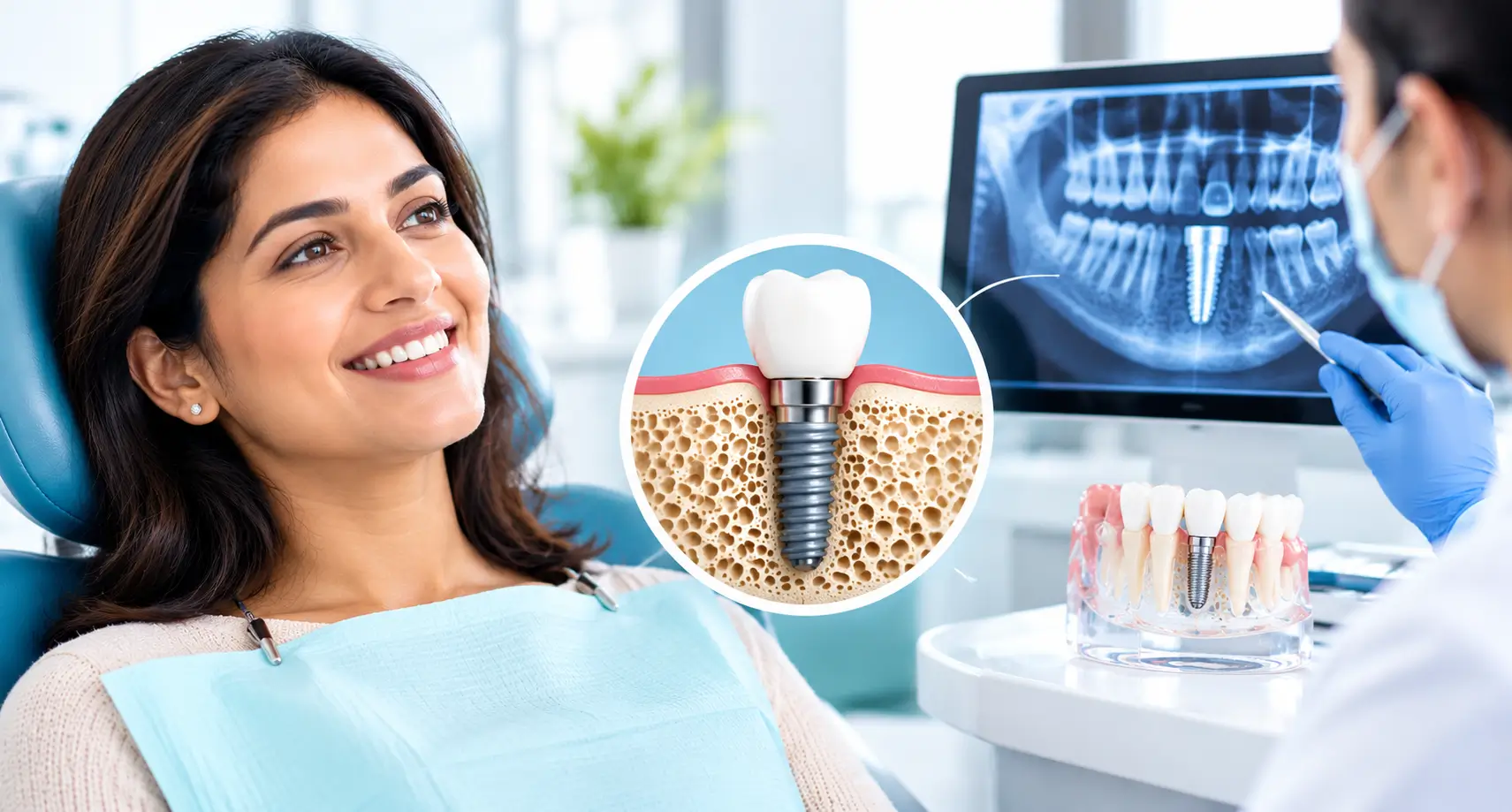


Being told that you do not have enough bone for dental implants can be disappointing, especially when you want a fixed, natural-looking replacement for missing teeth. However, insufficient jawbone does not always mean that dental implants are impossible. Depending on the amount and quality of the available bone, your oral health and medical history, several treatment approaches may be worth considering.
The key is to understand why the bone is insufficient and whether it can support an implant safely. At Dr. Inamdar’s Dental Studio in Mumbai, patients can discuss dental implant treatment and personalised restorative options with Dr. Aslam Inamdar, whose clinical experience spans more than 23 years. A thorough assessment helps determine which approach is appropriate for each patient, rather than recommending the same procedure for everyone.
Yes, some patients with low bone density or reduced jawbone volume can receive dental implants. However, suitability depends on the specific condition of the jawbone, the location of the missing teeth and other factors affecting healing.
A dental implant is a small post, commonly made from titanium, that is placed in the jawbone to support a replacement tooth, bridge or denture. For an implant to work reliably, it needs adequate bone support and sufficient initial stability. During healing, the surrounding bone gradually bonds with the implant surface through a process called osseointegration.
When the bone is too thin, too short or less dense than expected, achieving this stability can become more challenging. The dentist must determine whether an implant can be placed in the available bone, whether additional treatment is needed or whether a different tooth replacement option would be more suitable.
Low bone density does not automatically disqualify you from dental implant treatment. Equally, having some bone available does not guarantee that an implant can be placed safely. The decision should follow a proper clinical examination and imaging assessment.
Patients often use the terms low bone density and bone loss to describe the same problem, but they refer to different things.
1. Reduced jawbone volume
Jawbone volume refers to the amount of bone available in terms of height, width and shape. After a tooth is removed or lost, the surrounding bone may gradually shrink because it no longer receives the same stimulation from the tooth root.
If a tooth has been missing for several years, the remaining bone may be too narrow or too short to accommodate an implant in the ideal position. Bone grafting or another suitable approach may be considered, depending on the extent and location of the defect.
2. Low bone density
Bone density describes how compact or mineralised the bone is. When bone density is low, it may offer less initial resistance when an implant is placed.
This can affect surgical planning, the implant selected and the healing period before the replacement tooth is attached.
Low density does not always mean that the bone is too small in volume. A patient may have adequate bone dimensions but still require a more careful assessment of its quality.
3. Osteoporosis and its effect on dental implants
Osteoporosis is a condition in which bones become weaker and more prone to fractures. It can be relevant to dental implant planning, particularly when the patient is taking medicines that affect bone remodelling.
Having osteoporosis does not automatically mean that dental implants are unsuitable. The dentist needs to consider the severity of the condition, the medicines being taken, the patient's medical history and the planned surgical procedure.
It is especially important to disclose medicines such as bisphosphonates and denosumab, including the reason they were prescribed and how they are administered. Certain medicines, particularly those used in some cancer treatments, can increase the risk of medication-related osteonecrosis of the jaw after invasive dental procedures.
Never stop or change a prescribed medicine simply to undergo dental implant surgery. Any change must be discussed with the treating physician and dental team.
Several factors can leave a patient with insufficient bone to support an implant in the planned position.
Identifying the cause matters because the treatment plan for a patient with a narrow jaw ridge may differ considerably from the plan for someone with osteoporosis or severe bone loss following gum disease.
Before recommending dental implants for a patient with low bone density, the dentist needs to understand the condition of the bone and the surrounding structures.
Clinical examination and medical history
The assessment begins with an examination of the teeth, gums, bite and missing-tooth area. The dentist also reviews previous dental treatments, gum disease, infections, smoking habits and medical conditions that could affect healing.
Patients should disclose all prescribed medicines, supplements and previous surgical procedures. If a medical condition requires further evaluation, the dentist may coordinate with the patient's physician before proceeding.
Dental X-rays and CBCT imaging
Standard dental X-rays can provide useful information about the teeth and supporting structures. In cases where implant placement is more complex, cone beam computed tomography (CBCT) may be recommended.
CBCT creates a three-dimensional view of the jaw. It can help the dentist assess bone height and width, examine the relationship between the proposed implant site and nearby anatomical structures, and plan the implant position.
Three-dimensional imaging is particularly useful when the dentist is evaluating whether bone grafting, a sinus lift or another approach may be needed.
However, the scan must be interpreted alongside the clinical examination and the patient's overall medical history.
Assessment of bone quality and implant stability
Imaging can help estimate bone characteristics, but the dentist must also consider how the bone is likely to respond during surgery and healing. The implant position, design, surgical technique and the amount of available bone all influence the treatment plan.
The aim is not simply to place an implant. It is to determine whether it can be placed in a suitable position and supported well enough for the intended restoration.
There is no single solution for every patient. The appropriate treatment depends on whether the main concern is insufficient bone volume, reduced bone quality or a combination of both.
1. Bone grafting to rebuild the jawbone
Bone grafting is one of the options used when there is not enough bone to place an implant in the desired position.
During the procedure, graft material is placed in the area where additional bone support is needed. The material may come from the patient's own bone or from an appropriate donor-derived, animal-derived or synthetic source, depending on the clinical situation.
The graft provides a framework that allows new bone to develop as healing progresses. In some cases, a small graft can be performed at the same time as implant placement. Larger defects may require a separate grafting procedure followed by a healing period before the implant can be placed.
When may it be considered?
Bone grafting may be considered when the jaw ridge is too narrow or too short, or when bone is missing around an area planned for implant placement.
What should patients know?
Bone grafting adds complexity, cost and healing time. There are also risks, including swelling, bruising, infection, graft failure and the possibility of needing further treatment. It does not guarantee that an implant will become possible in every case.
2. Sinus lift for insufficient bone in the upper jaw
The maxillary sinuses are air-filled spaces located above the back teeth of the upper jaw. After upper molars or premolars are lost, the available bone beneath the sinus may become too limited for conventional implant placement.
A sinus lift, also called sinus augmentation, is a procedure that creates additional bone support in this region. The dentist carefully raises the sinus membrane and places suitable graft material beneath it.
After healing, the augmented area may provide sufficient bone height for implant placement. In selected cases, the sinus lift and implant placement can be performed together. In other cases, the graft needs to heal first.
Who may benefit?
Patients who have lost upper back teeth and have insufficient bone height beneath the sinus may be candidates, provided their anatomy and medical history support the procedure.
A sinus lift is not necessary for every patient with low bone density. It addresses a specific anatomical problem, namely insufficient bone height in the posterior upper jaw.
3. Implant placement with the available bone
Not every patient with reduced bone volume requires a graft. If the remaining bone can support an implant in a suitable position, the dentist may be able to proceed without a separate augmentation procedure.
The decision depends on the dimensions and quality of the bone, the location of important anatomical structures and the restorative result being planned.
In patients with lower-density bone, the clinician may need to adjust the implant selection, placement technique and healing protocol. The replacement tooth may also need to be delayed until adequate integration has occurred.
This approach should only be recommended when the available bone provides a sound basis for the planned implant and restoration.
4. All-on-4 or All-on-6 for extensive tooth loss
Patients who have lost most or all of their teeth may be evaluated for full-arch implant-supported teeth. All-on-4 and All-on-6 are treatment concepts that use four or six implants, respectively, to support a full-arch prosthesis in selected cases.
The implants are positioned according to the patient's anatomy and the requirements of the final restoration. Angled implant placement may help make use of available bone in certain cases and may reduce the need for some grafting procedures.
However, these treatments are not suitable for everyone with low bone density. The amount and distribution of available bone, the condition of the gums, the bite, medical history and ability to maintain the prosthesis all need to be considered.
The final number of implants and whether grafting is required must be determined after a comprehensive assessment.
5. Zygomatic implants for selected cases of severe upper-jaw bone loss
When bone loss in the upper jaw is extensive, conventional implant placement may become difficult. In carefully selected patients, zygomatic implants may be considered.
Unlike conventional dental implants, which are anchored in the jawbone, zygomatic implants obtain their primary anchorage from the cheekbone, also known as the zygoma. They are longer and require specialised surgical planning and experience.
They may offer an alternative for some patients with severe upper-jaw bone deficiency, including selected cases where conventional grafting would otherwise be considered.
However, zygomatic implants are complex procedures and are not a routine solution for low bone density. They carry specific risks and require careful evaluation by an appropriately trained and experienced surgical team.
Patients should ask about the clinician's experience with this procedure, the alternatives available and the expected maintenance requirements before making a decision.
6. Non-implant alternatives when surgery is unsuitable
Dental implants are not the only way to replace missing teeth. Depending on the patient's needs, a conventional bridge or removable denture may provide a more suitable option.
A dental bridge may be appropriate when neighbouring teeth can support the restoration. A removable partial or complete denture may be considered when surgery is unsuitable, the patient prefers to avoid surgery or the risks outweigh the expected benefits.
The right choice should account for comfort, appearance, chewing function, maintenance, cost and long-term oral health.
A responsible treatment plan includes explaining these alternatives rather than assuming that every patient must receive implants.
Osteoporosis deserves special attention because it affects bone strength throughout the body. However, a diagnosis of osteoporosis alone does not determine whether a patient can receive dental implants.
The dentist should consider several factors:
• Whether the osteoporosis is stable and being managed.
• Which medicines the patient takes and how they are administered.
• Whether the patient has additional medical conditions that may affect healing.
• The amount and quality of the bone at the proposed implant site.
• Whether bone grafting or another invasive procedure is planned.
Certain antiresorptive medicines, including bisphosphonates and denosumab, are associated with a risk of medication-related osteonecrosis of the jaw.
The level of risk varies according to the medicine, dosage, route of administration, reason for treatment and other patient factors.
This does not mean that every patient taking these medicines must avoid dental implants. It does mean that the decision should be made carefully, with medical input when needed.
For patients receiving high-dose antiresorptive treatment for cancer, the risks may be substantially different from those for patients receiving treatment for osteoporosis. A dental implant plan should reflect that difference.
The American Dental Association provides further information on osteoporosis medications and dental treatment.
Treatment time depends on the condition of the jawbone, the extent of any grafting and how well the tissues heal.
| Treatment Stage | What Happens |
|---|---|
| Initial Assessment | The dentist examines the mouth, reviews medical history, and evaluates imaging. |
| Bone Grafting, If Required | Additional bone support is created at the planned implant site. |
| Graft Healing | The area is allowed to heal before the next stage, when a separate graft is needed. |
| Implant Placement | The implant is placed once the site is considered suitable. |
| Osseointegration | The implant integrates with the surrounding bone before it is loaded as planned. |
| Final Restoration | A crown, bridge, or denture is fitted and adjusted. |
A minor graft may be completed at the time of implant placement, while a more extensive graft may require several months of healing first. Implant integration also takes time, and the final restoration should only be fitted according to the clinician's assessment of stability and healing.
There is no single timeline that applies to every patient. A dentist should explain the expected sequence, possible delays and follow-up appointments after examining the individual case.
When bone support is limited, choosing a clinic involves more than comparing implant prices or looking at before-and-after photographs. The clinician should be able to explain the diagnosis, available options and reasons for recommending a particular approach.
1. Experience with complex implant cases
Ask about the dentist's training and experience in implant treatment, bone augmentation and full-mouth rehabilitation, particularly if your case involves significant bone loss.
2. Appropriate diagnostic facilities
The clinic should have access to suitable dental imaging, including CBCT when clinically indicated. Three-dimensional planning can be valuable when the bone is limited or important anatomical structures are nearby.
3. A treatment plan based on your needs
The dentist should explain whether you need bone grafting, a sinus lift, a different implant strategy or a non-implant alternative. You should understand why the recommended treatment is appropriate for your case.
4. Honest discussion of risks and limitations
Ask about the possibility of graft failure, implant failure, infection, nerve injury, sinus complications where relevant and the potential need for additional procedures. No responsible clinic can guarantee that every implant will succeed or last a lifetime.
5. Long-term maintenance and follow-up
Implants require ongoing care. The clinic should explain how to clean the restoration, how often you need reviews and what to do if the implant or prosthesis becomes loose or uncomfortable.
6. A clear explanation of costs and treatment stages
A useful treatment estimate should distinguish the cost of the implant, any grafting or additional surgery, the final crown or bridge, temporary teeth where applicable and maintenance visits.
These questions help patients make a more informed choice, whether they are seeking treatment locally or travelling to India for dental care.
Dr. Inamdar’s Dental Studio offers dental implant treatment and restorative care in Mumbai, with treatment planning guided by the patient's oral health, clinical requirements and desired outcome.
Dr. Aslam Inamdar has more than 23 years of clinical experience, with work spanning dental implants, cosmetic dentistry and full-mouth rehabilitation. For patients with reduced jawbone support, a careful evaluation is particularly important because the treatment must address both the available bone and the design of the replacement teeth.
The clinic's diagnostic and planning capabilities include CBCT imaging, digital scanning and digital treatment planning where indicated. These tools can help assess the implant site, plan the position of the replacement teeth and evaluate the need for additional procedures.
The treatment discussion should cover the available bone, any medical factors affecting surgery, the possible need for grafting and the expected stages of rehabilitation. Where a case requires a procedure beyond the scope of the available team, referral or collaborative care may be appropriate.
For patients considering dental implants after being told that they have insufficient bone, the next step is not to assume that treatment is impossible or to proceed with surgery without further assessment. It is to obtain a clear explanation of the problem, the options available and the likely benefits and risks of each approach.
Patients can contact Dr. Inamdar’s Dental Studio or call us at +91 91373 77820 to arrange an assessment and discuss whether dental implants may be suitable for their individual needs.
Possibly. The answer depends on the location and extent of bone loss, bone quality and the position required for the implant. Bone grafting, sinus augmentation or selected alternative implant approaches may be considered. In some cases, a bridge or denture may be more appropriate.
No. Low density and insufficient bone volume are different issues. A patient may have enough bone volume for implant placement but still require a modified surgical plan. Bone grafting is considered when additional bone support is needed, not simply because the term low bone density appears in a report.
Some can. Osteoporosis alone is not an automatic reason to rule out implant treatment. The dentist must review the patient's medical condition, medicines, jawbone characteristics and individual surgical risks before making a recommendation.
The answer depends on the specific medicine, its dose and route of administration, the reason it is prescribed and the planned dental procedure. Some patients may be suitable for implant treatment, while others may face increased risks. The dentist should coordinate with the prescribing physician when appropriate. Patients should never stop their medicine without medical advice.
There is no universal best option. Depending on the anatomy and clinical circumstances, treatment may involve bone grafting, a sinus lift, conventional implants using available bone or zygomatic implants in selected complex cases. A thorough examination is needed to determine which approach is appropriate.
A separate bone graft often needs several months to heal before implant placement. The exact period depends on the size and type of graft, the site being treated and the patient's healing response. Your dentist should provide an estimated timeline based on your case.
No dentist can guarantee that an implant will last a lifetime. Implants can function for many years, but complications, bone loss, infection around the implant, wear or loosening of prosthetic components can occur. Good oral hygiene, regular reviews, suitable bite management and avoidance of smoking where possible support long-term maintenance.
A second opinion may be useful, particularly if the original recommendation was made without a detailed explanation of the bone findings or available alternatives. Take your existing X-rays, CBCT scans and medical records to the consultation. A second clinician may identify other options, but there is no guarantee that implant treatment will be suitable.
International patients can explore treatment in India, but complex implant treatment may require several visits or an extended stay. Bone grafting and implant integration often involve healing periods that cannot be shortened simply to fit a travel schedule. Before travelling, ask for a preliminary review of your records, a proposed treatment sequence, an estimated number of visits and a plan for follow-up care after returning home.
If you have missing teeth and have been told that your jawbone is too weak, thin or insufficient for dental implants, an individual assessment can help clarify your options.
At Dr. Inamdar’s Dental Studio in Mumbai, you can discuss your dental concerns, review the available diagnostic findings and understand whether implant placement, bone augmentation or another tooth replacement approach may be appropriate.
The goal is to develop a treatment plan that considers function, appearance, safety and long-term maintenance, with realistic expectations about the process and its limitations.
Contact Dr. Inamdar’s Dental Studio to arrange a consultation with Dr. Aslam Inamdar and discuss your dental implant options.

 Kurla Clinic
F12, 1st floor, Orchid Metropolis, S.G. Barve Marg, Opp. Shubh Sagar Restaurant, Near Kurla Railway Station, Kurla (E), Mumbai - 400024
Get Directions
South MumbaiShop No. 10, A Block, Sheriar Baug, Ramchandra Bhat Marg, Opp. Gate no. 2, J J Hospital, Mumbai - 400009
Get Directions