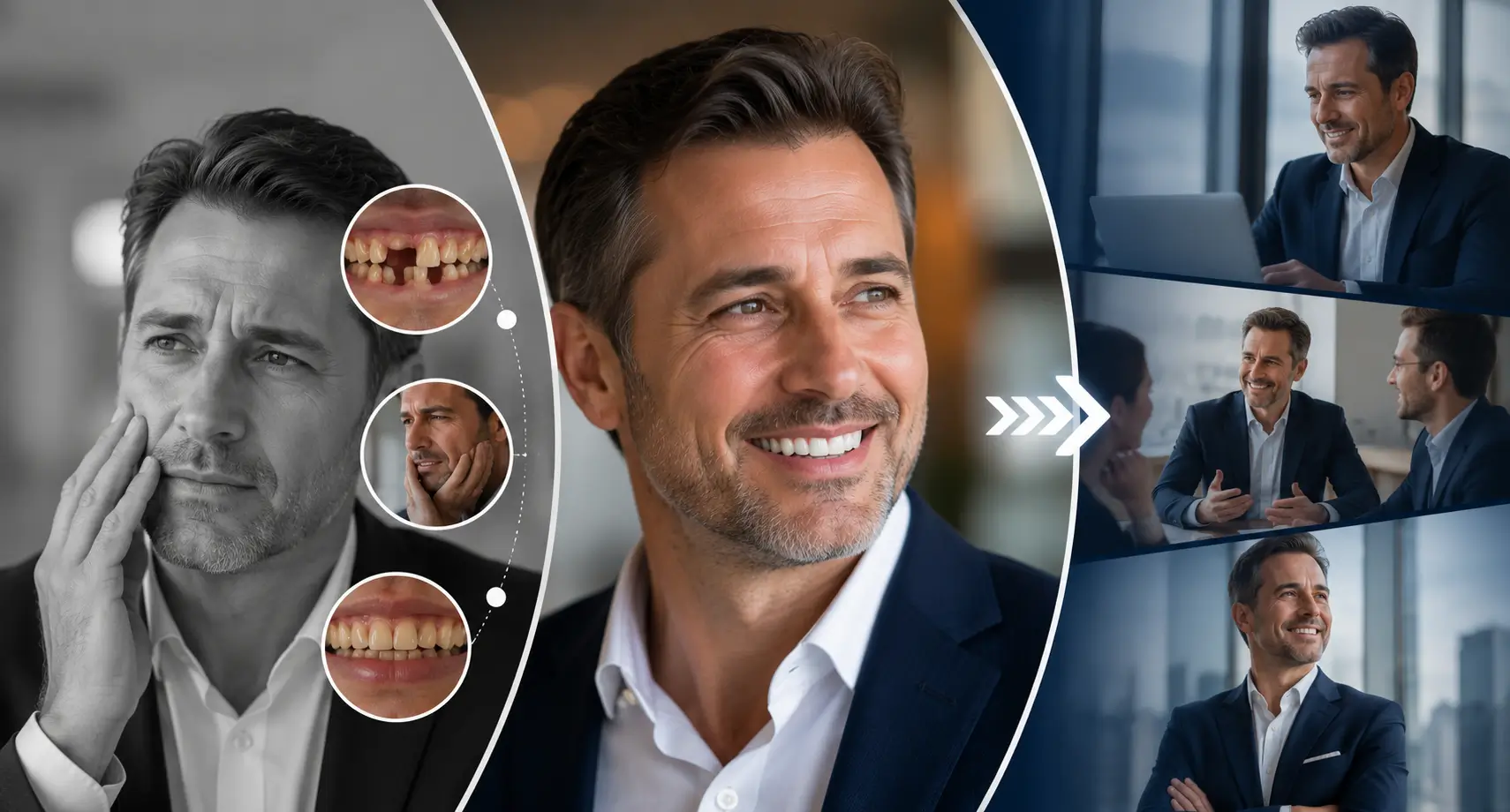


Before a client hears a pitch or a colleague reads an email, a judgment has usually already formed, based on nothing more than a face and an expression. Social psychology research has repeatedly found that people evaluate strangers on two dimensions almost immediately: warmth and competence. A smile is one of the fastest, most visible signals feeding into the first of those two.
These judgments form quickly, often before a single word is exchanged, and they tend to anchor how the rest of the interaction is read. A hesitant or closed-mouth smile, or one a person visibly holds back, doesn't erase that first impression. It just changes what gets communicated instead: discomfort, self-consciousness, or reserve, none of which are the message most professionals are trying to send in a client meeting or an interview.
A smile is read as a grooming and self-care cue in the same category as posture or how someone is dressed. Visible dental wear, discoloration, or damage doesn't just affect how a smile looks, it affects whether someone smiles freely at all, and a guarded smile reads differently than a natural one, even to someone who couldn't say exactly why.
Most articles on this topic reduce it to smile more, succeed more. The research doesn't actually support something that simple. A study published in the Journal of Consumer Research found that a broad, high-intensity smile doesn't uniformly improve how competent someone is perceived to be, its effect depends on context and on gender-based expectations in a given setting. A wide smile that reads as warm in one professional context can read as less serious in another.
What this suggests is more precise than generic confidence advice: the goal isn't to smile bigger. It's to remove the hesitation. A natural smile a person isn't holding back is a different signal than a performed one, regardless of how wide it is.
Most professionals who pursue smile treatment aren't chasing an aesthetic ideal. They're addressing something specific, worn edges, discoloration, a chipped tooth, that makes them self-conscious enough to hold back in photographs, on video calls, or in meetings. Treating the specific issue removes the hesitation, which is a more direct route to a natural-looking smile than any general cosmetic upgrade.
Treatment planning for this typically starts with a facial and bite evaluation, not just a look at the teeth in isolation, since the goal is a result that reads as natural rather than noticeably treated.
Research on first impressions consistently shows that facial cues, including a smile, factor into rapid judgments of warmth and trustworthiness. A smile someone holds back due to self-consciousness can affect that impression more than the smile's exact whiteness or alignment.
Not primarily. Most professionals seeking treatment are addressing a specific source of self-consciousness, worn teeth, discoloration, or damage, rather than pursuing a purely cosmetic ideal.
Not universally. Research indicates a broad smile's effect on perceived competence depends on context and setting. A natural, unhesitant smile tends to read more consistently well than deliberately smiling wider.
This depends on how much it affects day-to-day behavior, such as avoiding photos or holding back in meetings. An evaluation can clarify whether a minor cosmetic step or no treatment at all is the more appropriate option.
A smile evaluation is a reasonable first step for anyone who notices themselves holding back in photos, on calls, or in meetings because of how their teeth look. Dr. Inamdar's Dental Studio offers this evaluation at its Kurla and South Mumbai locations.

 Kurla Clinic
F12, 1st floor, Orchid Metropolis, S.G. Barve Marg, Opp. Shubh Sagar Restaurant, Near Kurla Railway Station, Kurla (E), Mumbai - 400024
Get Directions
South MumbaiShop No. 10, A Block, Sheriar Baug, Ramchandra Bhat Marg, Opp. Gate no. 2, J J Hospital, Mumbai - 400009
Get Directions