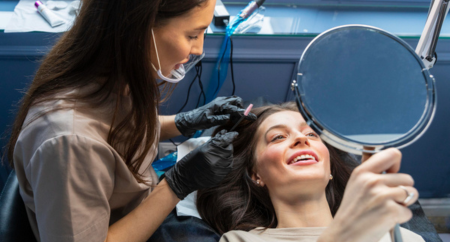


Not every patient who walks in asking for a smile makeover truly needs only a smile makeover.
Some cases gently—but clearly—ask us to look deeper.
She came to us through a reference. She had already undergone dental treatment elsewhere and was specifically looking for a natural-looking smile makeover. Her intent was clear: she wanted something refined, authentic, and long-lasting—not an artificial or overdone result.
In the process of researching the best options, she was guided to our clinic through a smile makeover reference. What stood out from the very beginning was her mindset—she wasn’t impulsive. She was observant, analytical, and genuinely interested in how things work.
As part of our routine protocol, her evaluation went beyond photographs and impressions. Using our 3D planning software and digital diagnostic tools, we began to study her case in detail.
That is when an important finding emerged.
There was a collapse of the bite—a condition that cannot be addressed with esthetic corrections alone. What initially appeared to be a cosmetic concern was, in fact, a functional problem requiring a comprehensive approach.
From a clinician’s standpoint, this moment is critical.
Proceeding with veneers or surface-level esthetics without addressing a collapsed bite would only compromise longevity and comfort.
This was not just a smile makeover case.
It was a full mouth rehabilitation case.
Once the diagnosis was clear, the focus shifted to planning—careful, structured, and transparent planning.
The treatment was broken down into slow, steady, and well-paced steps, ensuring that each phase respected biology, function, and the patient’s comfort. Time scheduling was deliberately peaceful—not rushed, not aggressive—allowing the body and the patient to adapt naturally.
What made this journey particularly rewarding was the patient’s mindset.
She trusted the process.
Being technically inclined, she understood the terminology, the logic behind the sequencing, and the importance of precision. This mutual understanding created an ideal doctor–patient dynamic—one built on clarity, trust, and shared decision-making.
Throughout her treatment, advanced digital dentistry played a central role—3D planning, realistic simulations, and modern equipment ensured accuracy and predictability.
But technology was never used to impress.
It was used to inform, validate, and execute.
Her video snippets often highlight this aspect—how thoughtfully technology was used, how each step made sense, and how realism was prioritized over exaggeration.
This is exactly how technology should function in modern dentistry: as a silent enabler of better outcomes.
As treatment concluded, the results spoke quietly but clearly.
Her smile looked natural.
Her bite felt stable.
Her confidence was visible.
She often expresses gratitude—not just for the final esthetic outcome, but for the honesty and direction provided throughout the journey. She remained open to necessary corrections because she trusted that each decision served a long-term purpose.
Today, she is happy, confident, and comfortable recommending our clinic to others—especially those seeking an aesthetic smile that is grounded in function.
She frequently mentions her admiration for the technology, the planning, and the modern systems in place—but more importantly, for how all of it came together seamlessly.
This case reinforces a vital principle:
A true smile makeover begins with function.
Esthetics follow naturally when the foundation is correct.
When patients trust the process and clinicians respect the diagnosis, the result is not just a beautiful smile—but one that lasts, feels right, and belongs to the person wearing it.
—
Dr Inamdar’s Dental Studio
Reach us at:
Kurla: +91 9137377820
Near JJ Hospital South Mumbai: +91 9820551749