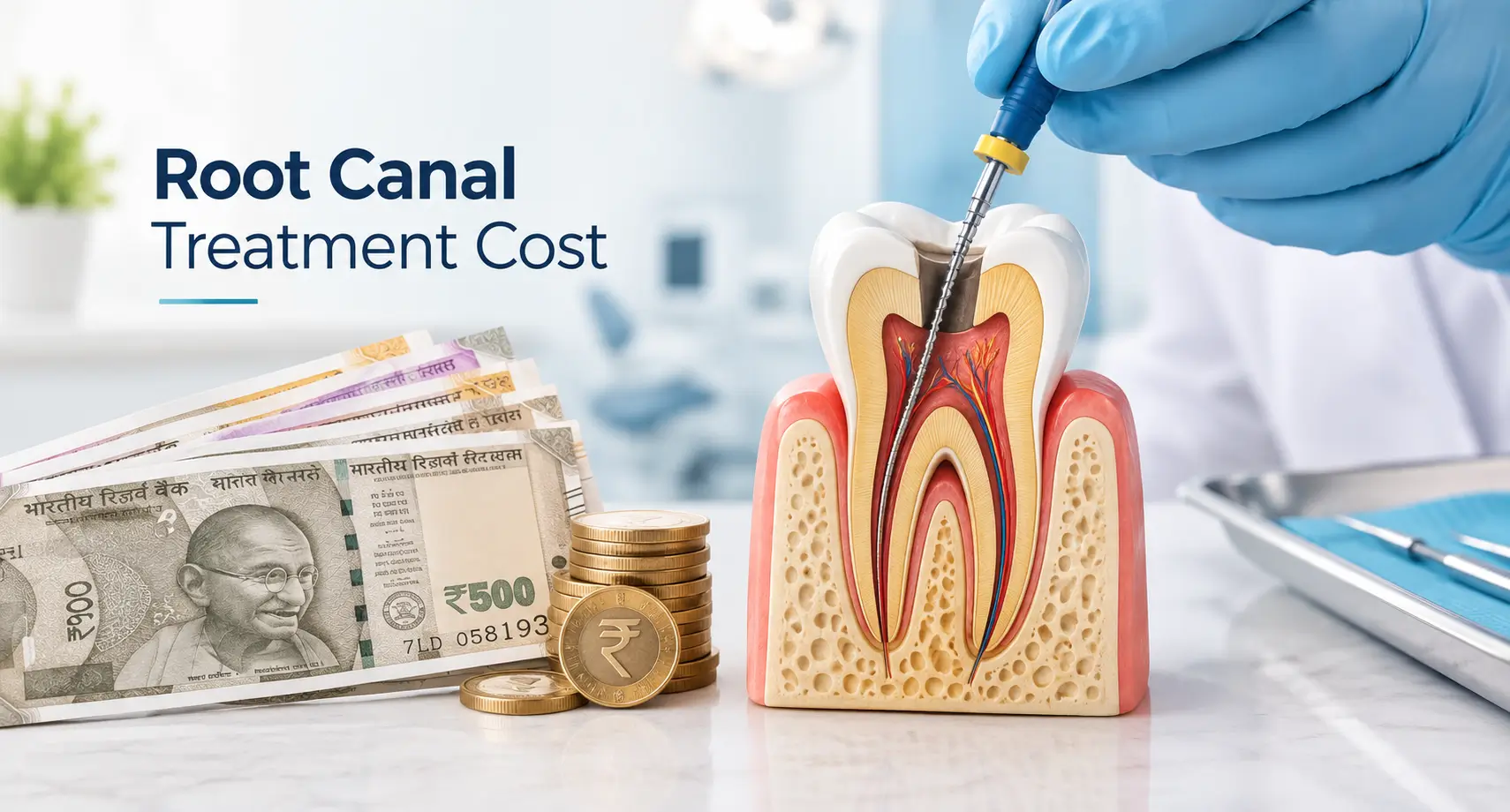


The cost of root canal treatment in Mumbai at Dr. Inamdar's Dental Studio starts from Rs. 3000 and can vary considerably from one tooth and one patient to another.
The final cost depends on factors such as which tooth is involved, the number and complexity of its canals, the extent of infection, whether it is a first-time treatment or retreatment, the technology required, and how the tooth needs to be restored afterward.
A front tooth with a relatively simple canal anatomy may require a very different treatment approach from a molar with multiple canals, calcification, previous treatment or a large infection.
More importantly, the objective of root canal treatment is not simply to remove pain. It is to eliminate infection, preserve the natural tooth and restore it so that it can continue functioning predictably for as long as possible.
This guide explains what you are actually paying for when considering root canal treatment in Mumbai.
Inside every natural tooth is a space containing the dental pulp, the soft tissue containing nerves, blood vessels and connective tissue.
When this tissue becomes irreversibly inflamed or infected, root canal treatment may be required.
Common causes include:
• Deep dental decay
• Cracks or fractures in the tooth
• Trauma
• Repeated dental procedures on the same tooth
• Leakage beneath an old filling or crown
• Infection around a previously root-canal-treated tooth
Possible warning signs include:
• Persistent or throbbing toothache
• Pain while biting or chewing
• Sensitivity to hot or cold that continues after the stimulus is removed
• Swelling around the tooth or gum
• A small recurring pimple or drainage point on the gum
• Discolouration of a tooth
• A cracked or chipped tooth
• Occasionally, no symptoms at all despite an infection visible on an X-ray
Symptoms alone cannot determine whether a tooth needs root canal treatment.
A proper clinical examination, pulp testing and digital X-rays are usually required. In selected complex cases, a CBCT scan can provide a three-dimensional view of the tooth, roots and surrounding structures.
Root canal treatment is generally charged per tooth. One of the major factors influencing cost is the anatomy and complexity of the tooth being treated.
| Tooth Type | Typical Root Canal Complexity | Cost Range (Per Tooth) |
|---|---|---|
| Front Teeth – Incisors/Canines | Often simpler canal anatomy | Rs. 3000 onwards |
| Premolars | One or more canals; moderate complexity | Rs. 4000 onwards |
| Molars | Multiple canals and more complex anatomy | Rs. 5000 onwards |
These figures represent the root canal procedure itself unless otherwise specified.
The definitive restoration—such as a filling, onlay or crown—is usually planned and charged separately.
The exact fee should ideally be determined after examining the tooth rather than quoting solely from a WhatsApp photograph or description of pain.
Good endodontic treatment begins with the correct diagnosis.
Before starting treatment, the dentist evaluates:
• Whether the tooth actually requires a root canal
• Whether the tooth can predictably be saved
• The extent of decay or fracture
• Existing bone and gum support
• Previous dental treatment
• Root and canal anatomy
• How the tooth will eventually be restored
At Dr. Inamdar's Dental Studio, digital radiography is routinely used for diagnosis. When additional three-dimensional information is clinically necessary—for example, in complex anatomy, suspected missed canals or selected retreatment cases—CBCT imaging may be advised.
The principle is simple: Diagnose first. Treat second.
Modern root canal treatment involves much more than simply “removing the nerve.”
The objective is to locate the canal system, clean and disinfect it thoroughly, shape it appropriately and seal it to reduce the possibility of reinfection.
Depending on the clinical situation, treatment may involve:
• Modern rotary or reciprocating endodontic instrumentation
• Electronic working-length determination
• Controlled irrigation and disinfection protocols
• Magnification where indicated
• Additional activation or disinfection techniques in selected cases
• Digital radiographic verification
Technology can improve efficiency and precision, but it does not replace clinical judgement, correct diagnosis and careful execution.
Some teeth require additional treatment before they can be predictably restored.
This may include:
• Core build-up
• Post and core when clinically indicated
• Removal of an old crown or restoration
• Temporary restoration between appointments
• Management of an existing infection
• Retreatment of a previously treated canal
• Management of calcified or difficult-to-locate canals
These procedures can influence the overall treatment cost.
This is where treatment planning becomes especially important.
A root-canal-treated tooth may already have lost significant tooth structure because of decay, previous restorations, fractures and the access required for treatment. This can make some teeth more susceptible to fracture under chewing forces.
However, not every root-canal-treated tooth automatically requires the same type of crown.
The final restoration should depend on:
• How much healthy tooth structure remains
• Whether the tooth is anterior or posterior
• Existing cracks or fractures
• The patient's bite and chewing forces
• Functional requirements
• Aesthetic requirements
Depending on the situation, the final restoration may be a bonded filling, onlay, overlay or full-coverage crown.
The aim should be to preserve as much healthy tooth structure as possible while providing adequate long-term protection.
| Restoration Type | Common Indication | Approximate Cost |
|---|---|---|
| Zirconia | Metal-free restoration with high strength | Rs. 8000 onwards |
| Lithium Disilicate / E-max | Selected aesthetic and adhesive restorations | Rs. 10000 onwards |
The material should not be selected by price alone.
The right restoration is the one appropriate for that particular tooth, bite and clinical situation.
When a tooth is badly damaged or infected, patients sometimes ask: “Wouldn't it be cheaper just to remove it?”
In the short term, extraction usually costs less.
When a tooth has a good restorative and periodontal prognosis, preserving it can often be a sensible biological and financial decision.
However, root canal treatment should not be performed simply to save every tooth at any cost.
A tooth with a severe vertical fracture, inadequate remaining structure, poor periodontal support or an otherwise hopeless prognosis may be better managed differently.
The goal is not to save every tooth. The goal is to save the right tooth, predictably.
Several clinical factors can influence the final fee:
• Complexity of canal anatomy: Teeth with additional, curved or calcified canals may require considerably more time and expertise.
• First treatment vs retreatment: Re-treating a previously root-canal-treated tooth is generally more technically demanding.
• Extent of infection: Larger or persistent infections may require additional management and follow-up.
• Number of appointments: Many suitable cases can be treated efficiently, while others are better managed over multiple visits.
• Specialist expertise: Complex cases may require treatment by an endodontist or a clinician with advanced endodontic training.
• Technology required: CBCT imaging, magnification and specialised endodontic equipment may be indicated in selected cases.
The lowest quotation therefore does not necessarily represent the same treatment protocol or complexity.
Dental coverage under health insurance in India varies significantly.
Some corporate or individual policies may provide limited dental benefits, fixed sub-limits or reimbursement under specific circumstances, while many standard health policies exclude routine dental treatment.
Patients should check directly with their insurance provider regarding:
• Whether root canal treatment is covered
• Annual dental limits
• Crown coverage
• Reimbursement requirements
• Waiting periods or exclusions
Modern root canal treatment is performed under local anaesthesia and should generally be comfortable.
In fact, the procedure is usually performed to relieve the pain caused by an inflamed or infected tooth.
Some tenderness while biting may occur for a short period afterward, particularly when significant inflammation or infection was already present.
Many straightforward cases can be completed in a single appointment.
However, the number of visits should be determined by the condition of the tooth—not by a promise of “single-sitting RCT.”
Teeth with significant infection, complex anatomy, drainage, retreatment requirements or other complications may benefit from treatment over more than one appointment.
Fast treatment is useful only when it is also appropriate treatment.
Not necessarily in every case.
Posterior teeth with substantial loss of tooth structure often require cuspal protection with an onlay, overlay or crown.
Some anterior teeth with adequate remaining healthy structure may be successfully restored more conservatively.
The decision should be based on remaining tooth structure, function and fracture risk, rather than applying the same restoration to every root-canal-treated tooth.
Some corporate and individual health insurance policies provide limited dental coverage, but this varies considerably.
Patients should confirm the exact benefits and exclusions directly with their insurer before treatment.
If an infected tooth genuinely requires root canal treatment, delaying care may allow the infection to progress.
This can result in:
• Increasing pain
• Swelling or abscess formation
• Further destruction of tooth structure
• Bone loss around the root
• Emergency dental treatment
• Eventually, loss of the tooth in some cases
Early diagnosis often gives the dentist more options to preserve the tooth conservatively.
A well-treated and properly restored tooth can remain functional for many years and, in favourable circumstances, for decades.
Long-term success depends on several factors, including:
• Quality of the root canal treatment
• Amount of healthy tooth structure remaining
• Quality and seal of the final restoration
• Gum and bone health
• Bite forces
• Oral hygiene
• Regular dental maintenance
The root canal and the final restoration should therefore be considered two parts of the same treatment plan.
When comparing root canal treatment costs in Mumbai, comparing only the price can be misleading.
Two quotations for “RCT + crown” may represent very different levels of diagnosis, complexity, treatment protocol, restorative planning and follow-up.
At Dr. Inamdar's Dental Studio, our approach begins by asking a more important question:
Does this tooth really need a root canal—and if it does, can we save it predictably?
Digital radiography and, where clinically indicated, 3D CBCT imaging help us understand the tooth before making that decision. The final restoration is then planned according to the remaining tooth structure, aesthetics, function and bite rather than following a one-crown-fits-all approach.
Because good dentistry is not about doing the most treatment.
It is about doing the right treatment, on the right tooth, at the right time.
Have tooth pain or been advised a root canal?
Book a consultation at Dr. Inamdar's Dental Studio for a clear diagnosis, prognosis and treatment plan before deciding how to proceed.

 Kurla Clinic
F12, 1st floor, Orchid Metropolis, S.G. Barve Marg, Opp. Shubh Sagar Restaurant, Near Kurla Railway Station, Kurla (E), Mumbai - 400024
Get Directions
South MumbaiShop No. 10, A Block, Sheriar Baug, Ramchandra Bhat Marg, Opp. Gate no. 2, J J Hospital, Mumbai - 400009
Get Directions