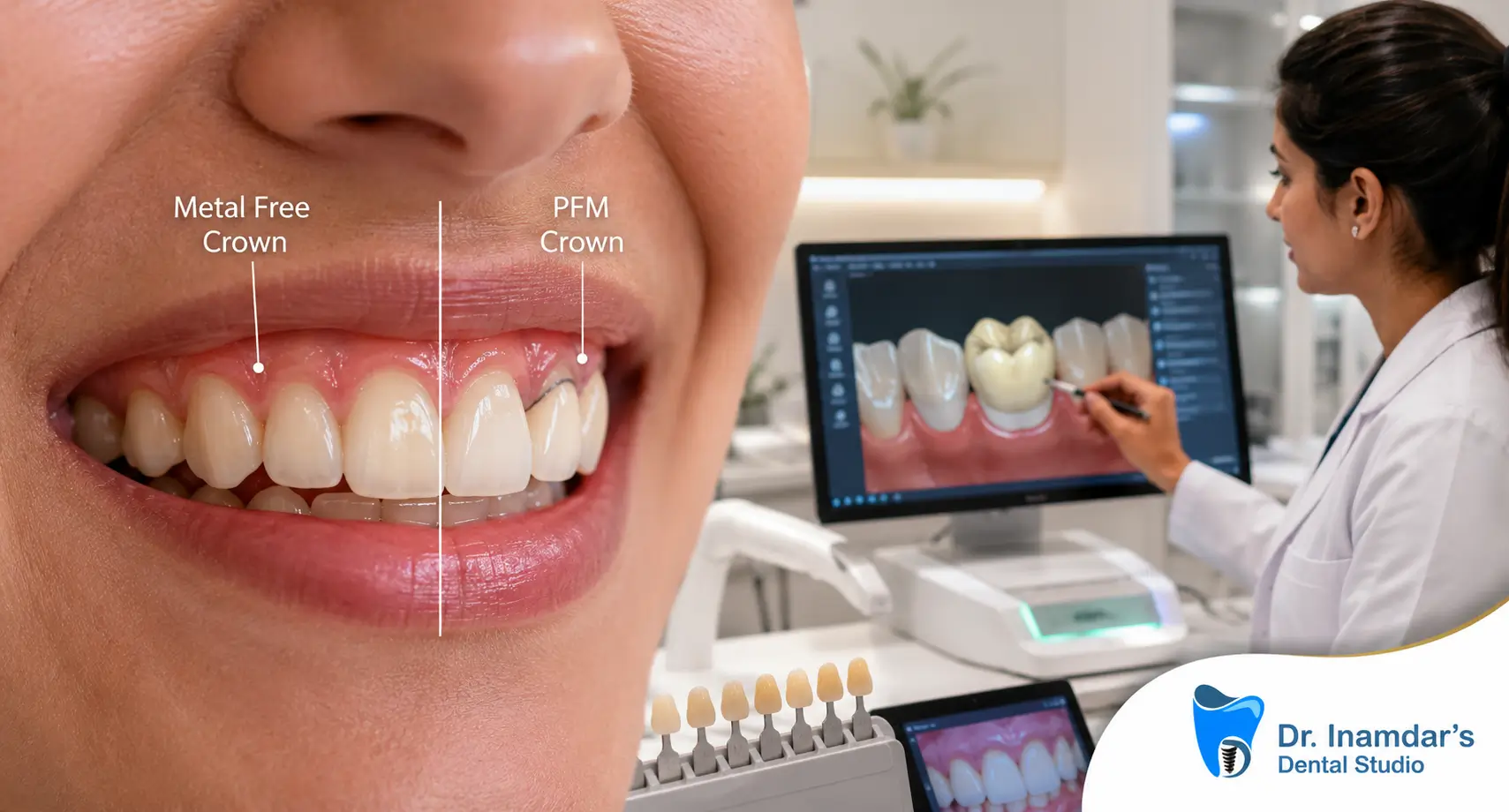


If your dentist has recommended a dental crown, you may have already searched online and found two common options: Metal Free crowns and Porcelain Fused to Metal (PFM) crowns.
One website says Metal Free crowns are the best. Another says PFM crowns are more durable. Some focus only on price, while others highlight aesthetics.
So, how do you decide?
The truth is, there is no single crown that is perfect for every patient. The right choice depends on several factors, including the condition of your tooth, where it is located in your mouth, your bite, your smile, and your long term treatment goals.
According to Dr. Aslam Inamdar, Prosthodontist and Implant Specialist at Dr. Inamdar's Dental Studio, one of the biggest misconceptions patients have is believing that crown selection is only about choosing a material.
"A crown is not simply a cap placed over a tooth. It becomes part of your bite, your smile, and your everyday function. The best crown is the one that suits your individual clinical condition, not the one that is most expensive or most popular."
That is why experienced dentists first evaluate the tooth and then recommend the most suitable restoration.
A dental crown is recommended when a tooth has lost significant strength and needs protection.
Common reasons include:
Rather than replacing the tooth, a crown protects the remaining natural structure while restoring strength, function, and appearance.
| Feature | Metal Free Crown | PFM Crown |
|---|---|---|
| Appearance | Excellent natural appearance | Good aesthetics |
| Light Reflection | Closely resembles natural enamel | Slightly more opaque |
| Metal Content | No | Yes |
| Gum Appearance | No dark metal margin | Metal margin may become visible if gums recede |
| Strength | Excellent with modern zirconia | Excellent due to metal framework |
| Best Suited For | Front teeth, smile makeovers, many back teeth | Selected back teeth and certain functional situations |
| Digital Dentistry Compatibility | Excellent | Good |
Rather than asking which crown is better, experienced clinicians ask which crown is more appropriate for that particular tooth.
One of the most searched questions is: "How much does a dental crown cost?"
The answer depends on several factors, including the material used, laboratory quality, treatment complexity, and whether additional
procedures such as a root canal or core build up are required.
| Crown Type | Approximate Cost in India* |
|---|---|
| PFM Crown | ₹3,000 to ₹7,000 |
| Metal Free Ceramic Crown | ₹6,000 to ₹12,000 |
| Zirconia Crown | ₹8,000 to ₹18,000 |
| E max Crown | ₹10,000 to ₹20,000 |
*Prices are approximate and may vary depending on the city, laboratory, complexity of treatment, and the treating dentist.
According to Dr. Aslam Inamdar, patients should look beyond the initial price.
"A dental crown is a long term investment in preserving your natural tooth. The right treatment should balance function, aesthetics, longevity, and the overall condition of the tooth rather than focusing only on cost."
There is no universal answer because every patient is different.
Generally, a Metal Free crown may be recommended when:
A PFM crown may still be suitable when:
The final recommendation should always be based on a comprehensive dental examination rather than a standard preference for one material.
Today, successful treatment is about much more than selecting a crown.
Modern digital dentistry allows clinicians to evaluate:
According to Dr. Aslam Inamdar, many long term crown failures are not caused by the material itself but by incomplete diagnosis or treatment planning.
"The material is important, but it is only one part of the equation. Long lasting restorations begin with careful diagnosis, precise planning, and selecting the right solution for each individual patient."
At Dr. Inamdar's Dental Studio, treatment planning follows this patient centred approach by combining clinical experience with digital workflows to improve precision and predictability.
Not necessarily. Modern zirconia crowns are extremely strong, but every material has specific indications. The best choice depends on the individual case.
Price alone does not determine quality. Proper diagnosis, treatment planning, and clinical execution play an equally important role.
Dental crowns are designed to last for many years, but their lifespan depends on oral hygiene, bite forces, regular dental check ups, and overall oral health.
Metal Free crowns generally provide the most natural appearance because they closely mimic the way natural teeth reflect light.
There is no single answer. The decision depends on the remaining tooth structure, bite forces, and the location of the tooth.
Yes. In some cases, especially if the gums recede over time, the metal framework may become visible near the gum line.
With proper planning, good oral hygiene, and regular dental care, many crowns continue to function successfully for many years.
Choosing between a Metal Free crown and a PFM crown is not simply about selecting a material. It is about selecting the restoration that best supports your tooth, your bite, and your long term oral health.
Modern dentistry is moving towards personalised treatment rather than one size fits all solutions. By carefully evaluating each patient's clinical needs, dentists can recommend restorations that balance strength, aesthetics, comfort, and durability.
As Dr. Aslam Inamdar explains, the most successful crown is not the one that looks impressive on the day it is placed. It is the one that continues to function comfortably, protect the natural tooth, and blend naturally with the patient's smile for years to come.

 Kurla Clinic
F12, 1st floor, Orchid Metropolis, S.G. Barve Marg, Opp. Shubh Sagar Restaurant, Near Kurla Railway Station, Kurla (E), Mumbai - 400024
Get Directions
South MumbaiShop No. 10, A Block, Sheriar Baug, Ramchandra Bhat Marg, Opp. Gate no. 2, J J Hospital, Mumbai - 400009
Get Directions